Sunday, March 6, 2011

Alexander Calder Inspired Circus Animal Sculptures and Drawings

     Our second grade artists just completed a unit about American sculptor Alexander Calder's Circus.  Before introducing the lesson to the students, I started by just showing them photographs of different animals (elephants, tigers, giraffes, dogs, parrots, and a mouse).  We discussed the similarities and differences between the animals and what special features each one had that an artist would need to include when they were making an artwork of the animal.  Then, without looking at the animal photos, the students followed my verbal instructions:
Begin by drawing a line for the ground at the bottom of your paper.
Draw an elephant standing on the ground.
Draw a giraffe standing on top of the elephant.
Draw a tiger standing on top of the giraffe.
Draw a dog standing on top of the tiger.
Draw a parrot standing on top of the dog.
Draw a mouse running by on the ground.
Add additional details to help viewers understand that your drawing is of a circus.

    Students completed these whimsical drawings in about 10 minutes, and then spent a little more time outlining, coloring with crayons, and painting with watercolors.


     To continue the unit, we watched video clips of Alexander Calder performing his miniature circus and discussed his work.  The kids were fascinated by the sculptures that could move and interact with one another in the artist's miniature circus.  For their sculptures, we started by making little clay pinch pots that we flipped upside down to create circus stools.  Then the kids chose their favorite animal from their animal tower drawings to sculpt.  The artists were challenged to make their animals interact with their circus stools in some way.  The sculptures were finished with semi-moist underglazes and clear glaze. 


THANK YOU to Miss Christina G. who won an art contest to "draw your own sun" with 8th Continent Soy Milk and won our school a Dick Blick art supplies gift card!  Christina came early to school a few times and helped me plan this lesson, and she chose the underglazes from Dick Blick's web site to order and use for these artworks!


Saturday, March 5, 2011

5th Grade Secret Boxes

Dylan W. 5-3

     The fifth graders just finished making self-portrait "secret boxes" with wonderful student teacher Miss Marin Ryan, where they made boxes using mixed materials to conceal a secret goal or fear.  The project was inspired by Frank Warren's PostSecret program, where people anonymously send in artistic postcards that reveal personal secrets.  Students discussed how sometimes it's okay to keep a secret until they are ready to reveal it, such as a secret fear or a secret goal for the future. 
     They each designed a stamp by making a symbol (using installation tape) for their chosen secret, and stamped it around the border of the box (we used a templates with photographs of the students copied onto tag board).  After that, they learned about contemporary Saudi Arabian artists who often work with the theme of secrecy, and they came up with creative ways to use collage to cover part of the face.  The result is a mixed-media self-portrait box that conceals a secret. 


Nick K. 5-1

Cody L. 5-3

Michael P. 5-1

Kayla M. 5-1


Thursday, March 3, 2011

Silent Buddies for Akron Children's Hospital


     The first graders just finished their "silent buddies" project (with student teacher Miss Marin Ryan), in which they made stuffed animals to donate to children at Akron Children's Hospital.  The students learned about how some children are in the hospital for long periods of time and can't always have their family with them.  When they found out that they would be making stuffed animals, or "silent buddies" to help comfort these children when they had to spend time alone, they were so excited for the special opportunity. 
     First they drew the outline of their stuffed animal, then Miss Ryan sewed the outline at home.  The students cut the animals out, turned them inside out, and stuffed them.  Finally the animals were colored with sharpie markers and tags were made to send along with the animal that had a personal note and picture.  The students are so excited to give the silent buddies to these children who will really appreciate them, and I am really proud of their hard work and generosity! 


"Take care of him please." - Savannah L.


     Great job, Miss Ryan, on a wonderful lesson!

Wednesday, March 2, 2011

The Art of Dr. Suess Fashion!


     I usually write about the wonderful artwork of our young artists here at Suffield, but I just have to post some photos from our Dr. Suess Day assembly this morning!  To celebrate the amazing artist and author Dr. Suess's birthday, our kids dressed up like their favorite characters from his many books.  The Cat in the Hat even came to visit too!  These photos are of just a few of the amazing costumes today!


Monday, February 28, 2011

Oil Pastel Landscapes

     In first grade, we already knew that landscapes are artworks of outside scenes, but we did not know that landscapes have three different parts.  We talked about some of the tricks artists use to make their artwork look super realistic.  One of those tricks is the use of scale.  We learned that the parts of a landscape that look the closest to us, and appear the largest are in the foreground.  We learned about the medium sized objects in the middle ground, and the smaller objects that look like they're far away from us in the background. 

    The students drew landscapes with all three parts in whatever season and whatever weather and time of day they wanted.  We then experimented with oil pastel color mixing to create these vibrant artworks.


Friday, February 18, 2011

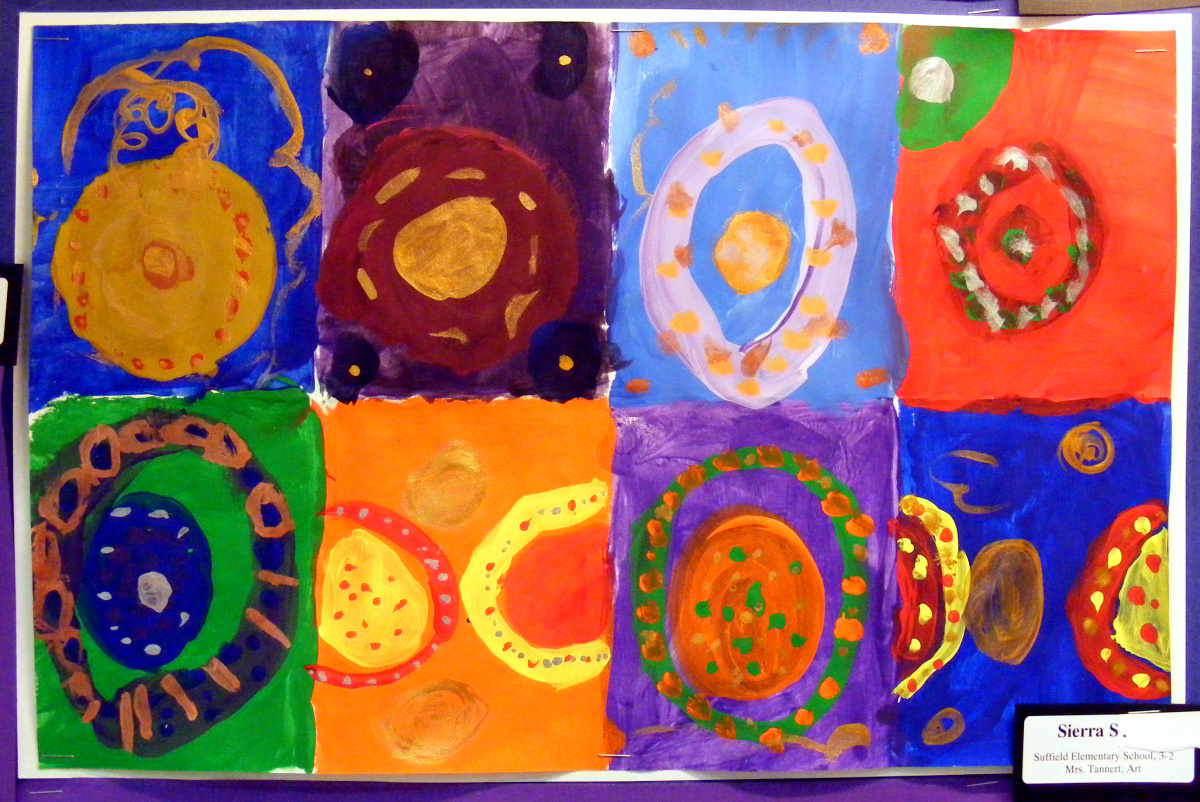
Third Grade Color Theory with Kandinsky


     Our third grade artists had a bigger color theory experience with these paintings than they've previously had.  We often talk about the primary colors, or warm and cool colors, but we don't often look at all of the main color families at the same time like we did for these paintings.  After learning about the importance of color choice to abstract painter Wassily Kandinsky, we learned a lot about the color wheel. 
     The students were challenged to create tempera paintings with blocks of primary colors, secondary colors, warm colors, cool colors, complimentary colors, tinted colors, shaded colors, and one free choice colors block!  In their blocks, students painted circles or parts of circles and completed their paintings with metallic tempera details.  Because the students were all using the same colors in their artworks, they were encouraged to add design elements that would make their painting look unique and like no one else's.
     Can you identify all of the color families??

Primary: red, yellow, blue
Secondary: orange, purple, green
Warm: yellow, orange, red
Cool: blue, purple, green
Complimentary: red and green, yellow and purple, and blue and orange
Tint: when white is mixed in to any color
Shade: when black is mixed in to any color


Friday, February 11, 2011

Oil Pastel Horses


     My wonderful friend Mrs. Susa at Lake Elementary School passed this great lesson idea on to me, and I thought we'd give it a try here at Suffield.  I am AMAZED by the incredible work our fifth grade artists created!  For the lesson, we looked at the role of the horse throughout art history (cave paintings, Native American hide paintings, Remington, Degas, Butterfield, etc.!), and then we started simple horse sketches (using pretty much just circles and ovals) and the students layered oil pastels from there.  We looked at a few artists who included unexpected colors in their work, and many students decided to try this too.


     To make these vibrant colors, the fifth graders created white oil pastel bases by using the side of the pastel.  Then they layered other colors to "build up" a life-like horse.  We also talked about highlights and shadows and the students were challenged to not just include these light and dark areas in the eyes, but also in the hair and other places.  They finished by making backgrounds of their choice in colors that would compliment their horses.